The archived UGC 11487 example
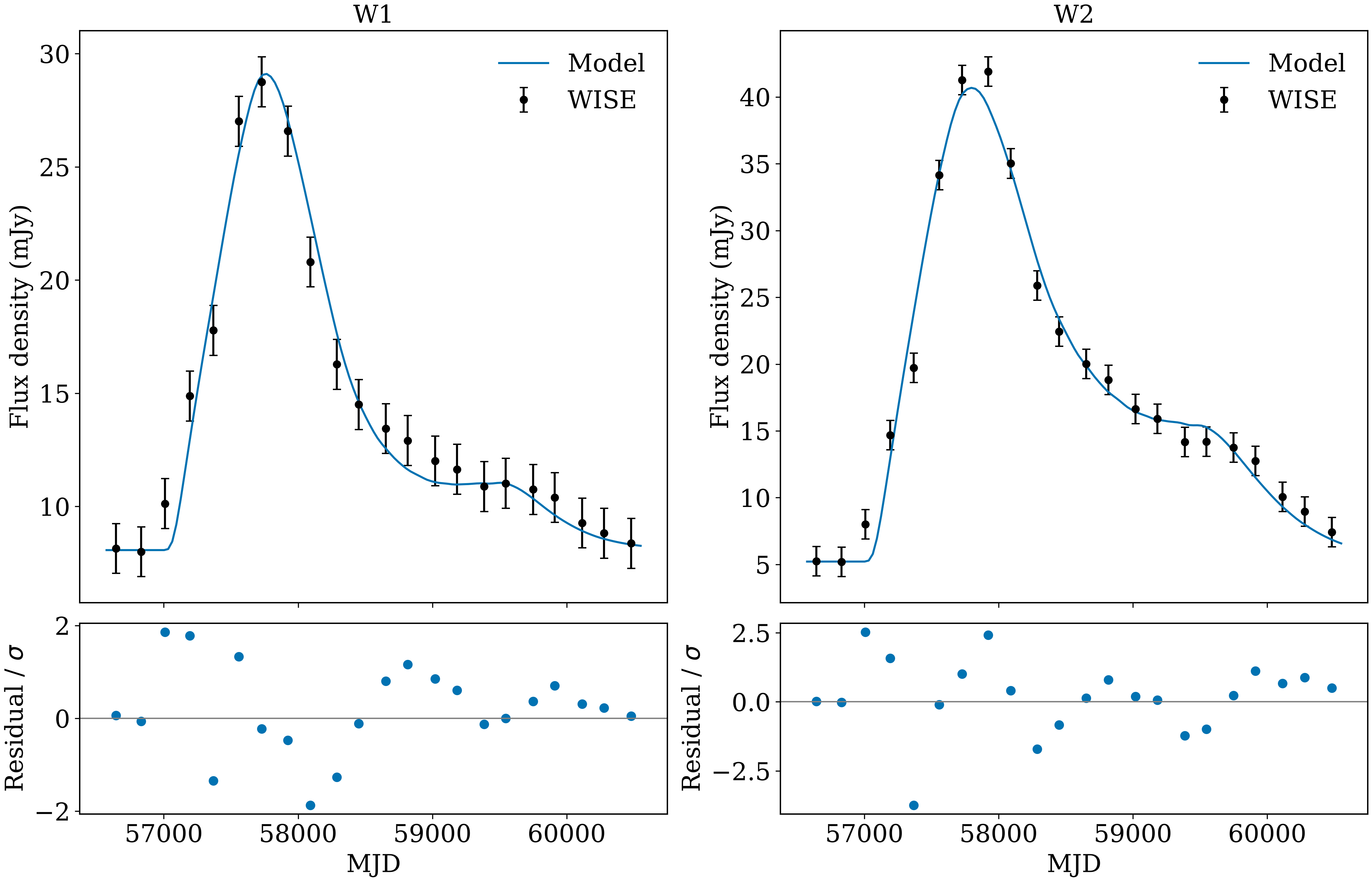
Case A is the locally refined reference solution. “Local” describes the search branch, not a different physical model. This website develops Case A as its worked example.
| Quantity | Case A |
|---|---|
| Total χ² | 58.95064072 |
| Nominal conditional ν | 37 |
| W1 / W2 χ² | 19.48798425 / 39.46265648 |
| t₀ (MJD) | 57063.03166039 |
| Maximum individual-grain temperature | 1143.5831 K |
| Sublimation threshold | 1793.2967 K |
| Source energy, simulated window | 8.63630287 × 10⁵¹ erg |
| Source energy, full driver | 8.66126663 × 10⁵¹ erg |
| Directly absorbed energy | 5.30131595 × 10⁵¹ erg |
| Eventually escaping IR energy | 5.30131040 × 10⁵¹ erg |
| Relative global energy residual | −1.0864 × 10⁻⁶ |
Interpretation
The observed two-band evolution admits a structured dust response with temperatures varying across radius, time, and grain size. A good fit does not uniquely identify a stellar encounter, radial density law, or grain composition. Geometry and dust prescription were held fixed in the local refinement.
The absorbed fraction of windowed source energy is approximately 0.614. It is not identical to a geometric covering factor. The energy ledger includes secondary absorption and re-emission.
Archived versus refined Case A
The figures and table above preserve the archived reference χ²=58.95064072. The later refined Case A has χ²=58.83195387879388 with a slightly different configuration. Its conditional endpoint checks belong to that refined reference, not the older example. Keep configuration, predictions and uncertainty products from the same version together.
Available products
examples/case_a contains the archived summary, exact physical configuration, observational predictions, response grid, thermal arrays, grain sizes, and energy ledger. The original provenance describes the author's environment. New runs produce new provenance because paths and runtime versions can differ.