Attribution and release terms
The model combines published physical prescriptions, externally maintained numerical tables and a project-specific transfer implementation. These sources have different roles and should be cited accordingly.
A background paper motivates a physical idea; an input file defines numerical data; source code defines the actual algorithm. Citing a paper does not mean that every mechanism in it is implemented, nor does it validate this solver’s convergence or fitted geometry.
Find a source
1. Scientific papers and adopted prescriptions
STARS fallback histories
Law-Smith, J. A. P., Coulter, D. A., Guillochon, J., Mockler, B. & Ramirez-Ruiz, E. (2020). Stellar Tidal Disruption Events with Abundances and Realistic Structures (STARS): Library of Fallback Rates. The Astrophysical Journal, 905, 141. DOI: 10.3847/1538-4357/abc489 · Author manuscript.
Used for: hydrodynamical fallback tables for particular stellar structures and encounters. V4.8 selects a supplied history, applies its adopted black-hole-mass scaling and then builds a luminosity driver; it does not rerun those hydrodynamical simulations or continuously interpolate all stellar models. The upstream documentation gives the scope of its non-relativistic rescaling.
Separate software citation: Law-Smith, J. A. P., Coulter, D. A. & Mockler, B. (2020), jamielaw-smith/STARS_library v1.0.5, Zenodo. DOI: 10.5281/zenodo.4062018 · Upstream repository. Upstream requests both paper and software citations. This archive identifies a specific STARS release, not this dust-echo code; it does not by itself prove that the local STARS_library-master copy is that version.
Causal accretion smoothing
Mockler, B., Guillochon, J. & Ramirez-Ruiz, E. (2019). Weighing Black Holes Using Tidal Disruption Events. The Astrophysical Journal, 872, 151. DOI: 10.3847/1538-4357/ab010f · Author manuscript.
Used for: the causal exponential-reservoir prescription relating fallback and accretion, discussed in §II.1.2 and equation (7). V4.8 has its own discrete implementation. It does not import that work’s full MOSFiT model, evolving photosphere or Eddington soft cap; the present luminosity is ηṀaccc² with a separate fixed source spectrum.
Grain-size distribution
Mathis, J. S., Rumpl, W. & Nordsieck, K. H. (1977). The Size Distribution of Interstellar Grains. The Astrophysical Journal, 217, 425–433. DOI: 10.1086/155591 · Original paper.
Used for: the MRN-type a−3.5 grain-number power-law context. Pure graphite and the 0.1–1 μm size range are this project’s fixed choices, not an unmodified copy of the original interstellar mixture.
Original graphite and silicate optical properties
Draine, B. T. & Lee, H. M. (1984). Optical Properties of Interstellar Graphite and Silicate Grains. The Astrophysical Journal, 285, 89–108. DOI: 10.1086/162480 · Original paper.
Laor, A. & Draine, B. T. (1993). Spectroscopic Constraints on the Properties of Dust in Active Galactic Nuclei. The Astrophysical Journal, 402, 441–468. DOI: 10.1086/172149 · Author-maintained data and provenance.
Used for: the adopted original Gra_81.gz and available Sil_81.gz optical-property tables. The graphite table uses the random-orientation 1/3–2/3 approximation. Only Qabs enters this absorption/re-emission solver; the tabulated scattering quantities do not make scattering active. The reference fit is graphite-only. These files must not be confused with the separately supplied updated 2003 dielectric functions or later graphite revisions.
Radiative-equilibrium and dust-physics background
Draine, B. T. (2003). Interstellar Dust Grains. Annual Review of Astronomy and Astrophysics, 41, 241–289. DOI: 10.1146/annurev.astro.41.011802.094840 · Author manuscript.
Used for: physical background on dust absorption, emission and grain properties. It supports the interpretation of Cabs and radiative equilibrium, not the claim that the current numerical inputs are a newer optical-table release.
Transient dust heating and echo geometry
Lu, W., Kumar, P. & Evans II, N. J. (2016). Infrared emission from tidal disruption events – probing the pc-scale dust content around galactic nuclei. Monthly Notices of the Royal Astronomical Society, 458, 575–581. DOI: 10.1093/mnras/stw307 · Author manuscript.
Used for: TDE dust-echo context, transient heating and light-travel geometry. That work also treats physical processes beyond this implementation. V4.8’s effective axisymmetric medium, instantaneous thermal equilibrium and static opacity must not be described as including all of its heating/cooling and sublimation evolution.
Density-dependent sublimation threshold
Baskin, A. & Laor, A. (2018). Dust inflated accretion disc as the origin of the broad line region in active galactic nuclei. Monthly Notices of the Royal Astronomical Society, 474, 1970–1994. DOI: 10.1093/mnras/stx2850 · Full text, §3.1.
Used for: equations (32)–(33), the density-based graphite/silicate sublimation-temperature approximations. They assume solar abundances and gas temperature 104 K, with n approximately the total hydrogen number density in cm−3. The paper quotes better than 0.5% accuracy for 1 < n < 1012 cm−3 under those assumptions. The active reference case uses only the graphite threshold. This is a size-independent domain check, not a simulation of the paper’s dusty-disc dynamics, evaporation timescale or opacity feedback.
WISE response and calibration
Jarrett, T. H., et al. (2011). The Spitzer-WISE Survey of the Ecliptic Poles. The Astrophysical Journal, 735, 112. DOI: 10.1088/0004-637X/735/2/112 · Author-institution archive.
Direct calibration documentation: NASA/IPAC IRSA, WISE All-Sky Release Explanatory Supplement, IV.4.h: Photometric Calibration, especially Table 1 and the equal-energy relative spectral responses. The response-file headers cite Jarrett et al.
The operator integrates FλREEdλ and divides by the same integral for Vega. It does not add λ/(hc) to an already equal-energy response. The official zero-point table gives 309.540 Jy and 171.787 Jy; the archived implementation uses the rounded constants 309.54 Jy and 171.79 Jy. These calibrated band values are not simply the target’s monochromatic flux at nominal band-centre wavelengths.
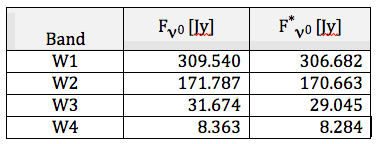
Mission context: Wright, E. L., et al. (2010), The Wide-field Infrared Survey Explorer (WISE): Mission Description and Initial On-orbit Performance. The Astronomical Journal, 140, 1868–1881. DOI: 10.1088/0004-6256/140/6/1868. The exact numerical calibration remains the identified response files and Vega standard, not the mission description alone.
CALSPEC Vega reference spectrum
Space Telescope Science Institute: CALSPEC calibration database, adopted file alpha_lyr_stis_011.fits.
Supporting database paper: Bohlin, R. C., Gordon, K. D. & Tremblay, P.-E. (2014). Techniques and Review of Absolute Flux Calibration from the Ultraviolet to the Mid-Infrared. Publications of the Astronomical Society of the Pacific, 126, 711–732. DOI: 10.1086/677655 · Author manuscript.
Used for: the Vega denominator in the WISE calibration. The adopted file combines observations with a 9550 K Kurucz model beyond 10,200 Å; W1/W2 therefore use its model extension, not directly observed STIS infrared fluxes. Preserve the _011 filename and fingerprint rather than silently replacing it with a current database revision.
2. Exact data products and upstream repositories
| Project input | Original source | Reproducibility note |
|---|---|---|
STARS input/m3.0_t0.0/0.850.dat | STARS source and data repository; v1.0.5 archive record | Record the selected file hash and the actual upstream version. The version DOI alone does not identify the bundled copy. |
Gra_81.gz | Original graphite table | 81 radii and 241 wavelengths in the original table; Qabs is interpolated within its supported domain. |
Sil_81.gz | Original silicate table | Available input, not the composition of archived Case A. |
RSR-W1.EE.txt | Official W1 equal-energy response | Response per unit energy; wavelength in μm. |
RSR-W2.EE.txt | Official W2 equal-energy response | Use the same energy-response convention as W1. |
alpha_lyr_stis_011.fits | Pinned CALSPEC Vega file | Å and erg s−1 cm−2 Å−1; do not replace with a newer version unnoticed. |
| UGC 11487 model-input table | Author-processed 22-epoch CSV | Canonical total fluxes, effective errors and fixed hosts. This is a project data product, distinct from instrument calibration files. |
The archived release manifest records the full input SHA-256 values. The input-provenance notes explain the narrower byte-for-byte restoration checks established for the selected fallback curve and canonical photometry.
3. Equations and implementation map
The links below are pinned to the website’s archived source snapshot, commit 64ff34ff91ea (6 October 2026), rather than a moving branch. The custom geometry, kernels and energy ledger are documented from these files; they are not attributed wholesale to an external paper.
| Topic | Active code or record | What to inspect |
|---|---|---|
| Public example | tools/run_case_a.py | Fine-resolution launch and a new output directory. |
| Fallback and luminosity | src/v4_driver.py | Mass scaling and causal smoothing; no imposed energy target. |
| Assembled calculation | V48_LOCAL_PAIR/solver.py | Conservative driver bins, source spectrum, observer conversion and transmitted source term. |
| Mesh and grain counts | build_mesh | Volume averages and optical-depth normalisation. |
| Paths and kernels | path_segments, build_transport, observer kernels | Three-dimensional paths, causal lags, absorption and escape. |
| Temperatures | Thermal | Per-grain equilibrium, Newton corrections and static-opacity gate. |
| Secondary heating and energy | solve_time_rt | Nonlinear iteration, finite-window accounting and tail checks. |
| Optical interpolation | src/v4_opacity.py | Logarithmic interpolation of positive Qabs with bounds checks. |
| Grain weights and calibration | src/v4_wise_emission.py | Number-weight bins, WISE zero points and Vega band signal. Legacy relative-response helpers are not the active absolute-emission path. |
| Threshold formula | sublimation_temperature_K | Only the threshold is used here; retained survival functions do not imply active destruction. |
| Likelihood and epoch | profile | Fixed-host flux residuals and bounded t₀ profiling. |
| Archived results | examples/case_a/summary.json | Matched fit, active resolution, energy ledger and temperature gate. |
4. Versions, checksums and citation practice
For a result derived from this model, identify the exact code commit or released version, configuration, selected fallback table, optical/calibration files, active numerical settings and saved-output provenance. Cite the scientific inputs above as well as the UGC 11487 analysis and the model software when their final citation records are available.
The inspected preparation package identifies version 0.1.0-rc1 and provides a citation template. It does not establish a final software author list or a DOI for this dust-echo code. Do not substitute the STARS DOI for the project’s own identifier or invent a software citation. A separately labelled later fit should have its own matching tables, arrays, uncertainty record and provenance.
5. Project and third-party terms
The public repository preserves its owner-selected CC0-1.0 project licence. External tables and software retain their own applicable terms and attribution; the project licence does not relicense them.
The third-party checklist and preparation audit contain unresolved release-metadata and redistribution-review items. Their references to preparation before publication are historical, not a claim that the current website is private. Confirm the applicable source terms for a versioned redistribution, or provide official download instructions and checksums instead. Public availability alone does not establish permission under a new licence.